

If you want to become clairvoyant, it helps to begin with a clear distinction: you can explore imagery, dreams, and intuitive impressions without assuming that they provide information beyond ordinary perception. No exercise in this guide establishes or guarantees paranormal sight.
In spiritual usage, clairvoyance is commonly described as clear seeing. Some people interpret mental pictures as psychic impressions; others understand similar experiences as memory or imagination. A vivid image can be meaningful without being factually accurate, and an image’s apparent clarity does not identify its source.
Quick Guide
Choose a short, low-stakes activity. Write observations before interpreting them, keep any factual claim specific, and record misses as carefully as matches. You do not need a special room, paid course, crystal, or unusual experience. Being able to stop and reconsider matters more than feeling certain.
Set a Goal You Can Actually Check
“I will become psychic this month” is not a useful starting measure. “I will accurately record five details of an object” or “I will keep the original wording of one impression” gives you a clear task.
Keep the labels modest. Observation practice is observation practice. Remembering a card you previously saw is memory. An imagined scene is not automatically a vision of an event. Our guide to psychics and clairvoyant psychics explains the terminology without treating a label as proof.
It is also acceptable to discover that the activity is not interesting to you. Persistence does not guarantee a supernatural result, and lack of progress does not demonstrate a hidden blockage. Do not buy repeated “activations” because someone says ordinary doubt is the only thing preventing success.
Dreams: Record First, Interpret Later
A dream journal can preserve a personal experience. If you naturally remember a dream on waking, write a few lines about the scene and feelings. Keep your normal sleep routine; you do not need to wake repeatedly or deprive yourself of rest to collect material.
Put your interpretation in a separate paragraph. “I dreamed of a red door” is an observation about the dream. “That means my friend will move house” is an additional claim. A resemblance noticed later does not turn the whole dream into a verified prediction.
You may interpret a dream within your spiritual beliefs, but this guide does not promise that guides will answer requests, that the soul travels during sleep, or that recurring imagery reveals a previous life. If dreams are upsetting or affecting your rest, prioritize support rather than trying to intensify them.
Messages: Keep Your Own Judgment
When an image or phrase seems important, ask what it actually contains and what you are adding. A remembered conversation, an expectation, or something recently seen may be relevant. “I do not know” is a complete answer when the source is unclear.
Do not treat an impression as permission to diagnose someone, accuse them of dishonesty, contact them after a boundary, or make a major financial or health decision. The person concerned has authority over their own choices and private information.
If you want to reflect, write “This brings up the question…” instead of “This proves…”. That can turn an impression into a useful question without claiming access to another person’s mind.
Visuals: Try a Simple Observation Exercise
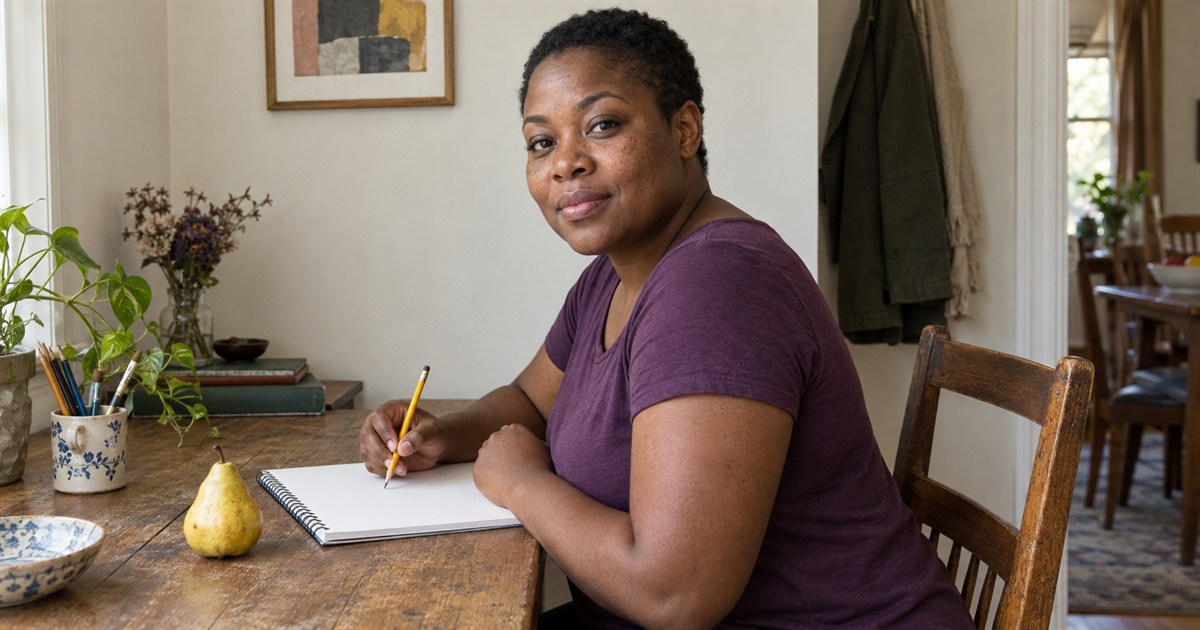
Place an ordinary object, such as a pear, mug, or leaf, where you can comfortably see it. Spend a minute noticing its shape, color, texture, and position. Look away and write five details from memory, then look back and compare.
Keep the details you got wrong. Perhaps the pear’s stem leaned left rather than right, or the mug’s handle was smaller than you remembered. Those corrections are the point: you are comparing a recollection with an available object, not proving that information arrived without your senses.
If voluntary mental pictures are difficult or absent, use descriptive words or sketch while looking at the object. University of Exeter’s overview of aphantasia research explains that lacking visual imagery does not mean lacking imagination. You do not need to force a picture or interpret the difference as a closed third eye.
Imagining numbers from one to ten can be a voluntary imagery activity if you enjoy it, but it is not a demonstrated way to open an energy center. Stop when you choose, and use written numbers instead if that suits you.
Games: Separate Memory From Concealed Information
A matching-card game or a tray of objects can be enjoyable. Once you have seen the cards or objects, however, remembering them involves prior information. Do not call an improved score proof of psychic sight.
Concealed-card activities raise a different question, but informal attempts can include ordinary clues or flexible scoring. A friend’s expression, a marked card, or knowing which cards remain can all affect a guess. “Sending” a picture with your mind is a spiritual interpretation, not something the game establishes by naming it that way.
What a Fairer Check Would Need
- A fixed question: Specify the target choices and what exactly is being predicted.
- Random selection: Prevent a predictable sequence or deliberate choice from determining the targets.
- No ordinary clues: Protect against seeing the target, card markings, reflections, sounds, or feedback from someone who knows the answer.
- Advance scoring: Decide what counts before seeing the target; do not add partial-credit categories afterward.
- A fixed stopping point: Do not stop only when the result looks impressive or silently discard an unsuccessful run.
- Complete records: Retain every planned attempt, including misses and procedural mistakes.
- Independent follow-up: A casual result needs more scrutiny and replication, not an immediate claim of certification.
For example, with five equally likely choices selected independently each time, an uninformed guess has a one-in-five chance of matching. Random results can vary, and a short streak is not enough to establish an extraordinary source. Without a suitable design and analysis, an informal score should remain an informal score.
Plan an Impressions Log Before the Outcome
The Center for Open Science describes preregistration as specifying a research plan in advance and submitting it to a registry. It helps distinguish planned tests from later exploration. A private notebook is not formal preregistration, but you can borrow the useful habit of fixing your claim before checking it.
For one low-stakes impression, record these eight fields:
- Date and time: When the impression occurred.
- Exact content: The original image or words, without later additions.
- Specific claim: What you think will happen, if you are making a prediction.
- Prior information: Anything already seen, heard, remembered, or expected.
- Alternatives: Other plausible outcomes or ordinary explanations.
- Check and deadline: How and when the claim can be assessed.
- Scoring rule: What will count as a match, miss, or unresolved entry.
- Actual result: Added later without editing the original claim.
“Something will change” is too broad to score fairly. “The library will confirm by Friday that Saturday’s workshop is canceled” is specific enough to compare with a normal update. Neither phrasing makes the prediction true; specificity simply makes an honest check possible.
Worked Example: Keeping the Miss
Fictional example: Sol sees an imagined blue envelope while thinking about a small exhibition application. She interprets it as a possible acceptance and writes, “The organizer will send an acceptance email by noon on Wednesday.”
Her prior-information field says that decisions were already expected that week. Her alternative is a rejection or delayed response. Her scoring rule requires an actual acceptance by the deadline, not any message with a blue logo.
On Tuesday, the organizer sends a rejection. Sol marks the acceptance claim as a miss. She does not count the email’s blue header as success or say the rejection secretly means acceptance elsewhere. The image can still become a sketch idea; the application decision is a separate fact.
Her practical next step is to read any feedback and decide whether to apply elsewhere. A notebook that preserves this outcome is more useful than a collection that retains only flattering coincidences.
Meditation and Crystals Are Optional
You do not need to eliminate your logical mind or force sensations between your eyebrows. If you want a quiet moment, keep it brief and comfortable, with ordinary breathing and awareness of your surroundings. No vision has to appear.
NCCIH notes that meditation safety research is limited and negative experiences can occur. Stop if it is uncomfortable, and do not use it instead of appropriate care. More intensity is not automatically more useful.
Lapis lazuli or clear quartz may be attractive personal reminders, but this guide does not present them as proven tools for psychic sight. You can use a pencil, a note, or no object at all. You do not need to purchase anything to complete the activities here.
Keep the Practice Safe and Proportionate
Pause if you become distressed, lose sleep, neglect responsibilities, or feel unable to stop checking impressions. Do not press on your forehead or stare at bright light to generate visual effects.
New visual symptoms should not be assumed to be a third-eye event. NHS guidance calls for urgent assessment of new or sudden floaters or flashes and related warning signs such as a curtain over vision, blurred vision, or eye pain. For voices without an apparent source, seek medical advice rather than assuming a guide is speaking; NHS voice guidance explains when urgent or emergency help is needed.
A sensible next step is one object-observation exercise or one carefully written impression, followed by an ordinary activity. For more perspective, 11 signs people associate with clairvoyance explains why broad experiences are not a diagnostic checklist. Curiosity and careful doubt can coexist.
Frequently Asked Questions
Can a routine guarantee that I will become clairvoyant?
No. The exercises here can support observation, imagination, and careful record-keeping, but they do not establish or guarantee paranormal sight. Lack of unusual experiences is not evidence that you are blocked or failing.
Are vivid dreams proof of clairvoyance?
No. A vivid or meaningful dream does not establish a spirit message, past life, or prediction. Record it as a dream, separate later associations from the original note, and do not make important decisions from the imagery alone.
What if I cannot picture things in my mind?
You can use words, sketches, or descriptions of an object you can see. People vary in voluntary mental imagery, and aphantasia is not proof of a spiritual blockage. You do not need to force an inner picture to take part in a reflection exercise.
Does a memory game test psychic sight?
No. If you have already seen the objects or cards, recalling them tests memory and observation. A concealed-target activity needs advance rules, randomization, protection against ordinary clues, and complete records, and a casual result still does not prove an ability.
What should go in an impressions log?
Before checking, record the exact claim, time, prior information, alternative explanations, deadline, and success and miss rules. Add the actual outcome later without changing the original. Keep unresolved entries and misses, not just memorable matches.
Do crystals or forehead tingling show that a third eye is opening?
No. A crystal can be a personal reminder, but it does not verify psychic sight. A sensation in the forehead is not a test of an energy center. Do not press on the area, force sensations, or substitute a spiritual explanation for needed care.
When should I stop practicing?
Stop if an exercise causes distress, disrupts sleep or daily life, or makes you feel compelled to keep checking. Seek appropriate medical help for new visual symptoms or voices without an apparent source. You are free to stop without completing a session or proving anything.