

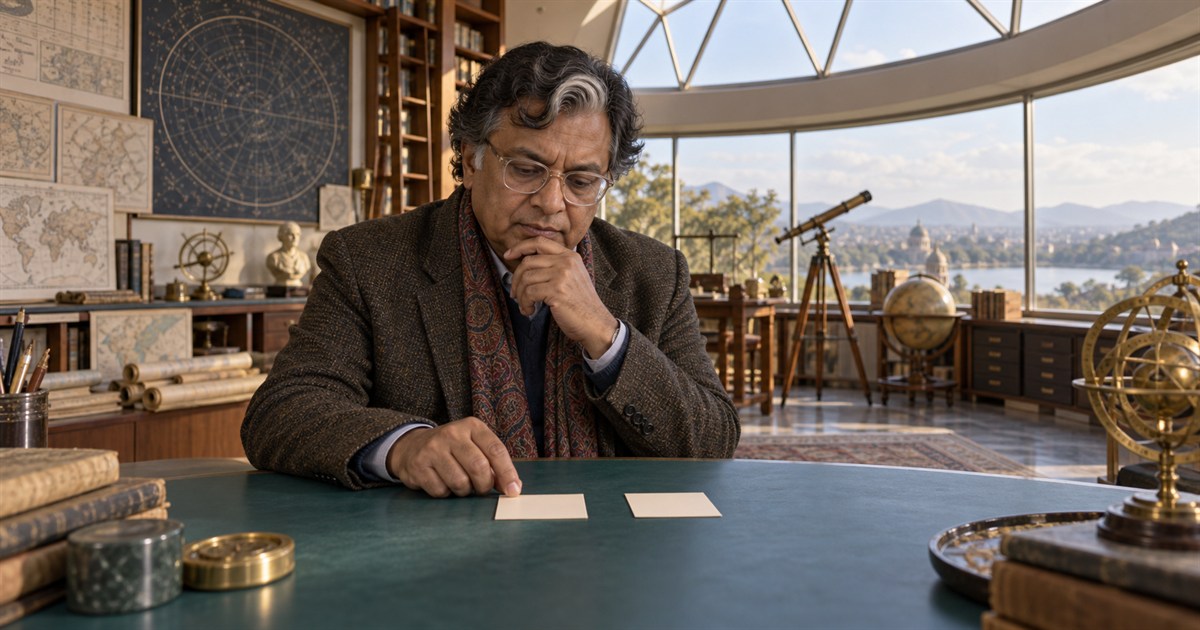
Making the best of an interest in clairvoyance starts with a useful distinction: noticing an impression is not the same as knowing it is accurate. You can be curious about an image, hunch or coincidence while asking what ordinary information, expectation or chance might explain it.
Rather than promising that everyone has hidden powers waiting to unfold, this guide focuses on a skill you can actually practice: recording what you thought before you know the outcome, then reviewing it fairly. That approach leaves room for personal spiritual meaning without turning uncertainty into certainty.
Quick Guide
Write the exact impression first. Define a clear outcome and deadline, note what you already knew and keep every result. Do not change the wording after the event. Use low-stakes topics only; health, money, safety and another person’s consent should never depend on an unverified impression.
What are you trying to improve?
Merriam-Webster defines clairvoyance in terms of perceiving beyond ordinary sensory contact. A definition explains how a word is used; it does not establish that a particular person has the ability. Vivid imagination, careful noticing and a spiritual interpretation are also different things, even when they feel similar.
Set a goal that does not assume its conclusion. “I want to describe my impressions more precisely” is something you can review. “Every coincidence proves my power is growing” leaves no room for an unfavorable result. Our guide to exploring whether you identify as clairvoyant discusses that distinction further.
You do not need to abandon skepticism or force yourself to believe. A useful practice should allow the answers “I was mistaken,” “I already had a clue” and “I do not know.” Those answers are not signs of a blocked chakra.
Make a before-the-outcome record
The Center for Open Science explains preregistration as specifying a research plan before the relevant study work, helping distinguish planned tests from ideas developed after seeing results. A private journal is not a registered scientific study. You can nevertheless borrow the straightforward habit of writing the rules before you check the answer.
For each low-stakes impression, record:
- Time: When did you write this down?
- Exact impression: What did you actually think, without adding later details?
- Target and deadline: Which event or item are you checking, and when does the question close?
- Match rule: What would count as correct, incorrect or impossible to determine?
- Prior information: What did you see, hear, read or already expect?
- Outcome: What independently checkable result became available?
- Review: Did the result meet the original rule, and what alternative explanation remains?
Keep the first entry unchanged. Add a separate dated note when you learn more. If you prefer broader reflective prompts rather than outcome checking, use our journal prompts for exploring psychic beliefs.
Specific statements are easier to check
Compare these original examples:
- Too flexible: “Something important will happen soon.” Almost any later event could be made to fit, and “soon” has no agreed endpoint.
- More specific: “The next card, drawn under the rules below, will be red.” There is one stated outcome and a defined check.
- Already informed: “My friend will call tonight” when the friend usually calls every Thursday. A correct expectation does not show that ordinary knowledge was absent.
- Not a fair check: “My partner secretly regrets our conversation.” Without an independently established outcome, you cannot score a private thought as a match.
Specificity does not make a statement true. It makes it possible to see when the statement was wrong. Do not expand “red” into “a warm feeling” after a black card appears, or turn a missed deadline into a prediction for some later date.
A low-stakes card exercise, with limits
If you enjoy card guessing, treat it as a short exercise in record-keeping, not certification of a gift. Use a standard deck without jokers and choose only red or black as the target. Before starting, write a fixed number of attempts, such as ten, and an exact-match scoring rule. There is no score in this exercise that qualifies someone as clairvoyant.
On each attempt, record one choice before revealing a card. Return the card to the deck and shuffle thoroughly before the next attempt. Avoid looking at faces, marked backs or reflections. Do not add extra attempts because the score is disappointing, and do not stop early to preserve a lucky run.
In a standard deck, 26 of 52 cards are red. With a uniformly random draw, the chance of red is therefore 26/52, or one half. Across ten independent fair draws, five correct red-or-black guesses is the expected average, not a guaranteed result. A different total can occur by chance.
A home shuffle may not be uniformly random, and other unnoticed cues can remain. Even a surprising result would need careful independent evaluation, controls and replication before supporting a paranormal explanation. The value of the exercise here is noticing how you record and interpret results, not proving a power.
Review misses as carefully as matches
At the end, count every planned attempt. Do not leave out a miss because you were tired, distracted or less confident unless an exclusion rule was written beforehand and is reported transparently. A reason discovered after seeing the outcome may be worth noting, but it should not silently change the score.
For example, in a fictional ten-attempt log, Casey records six correct choices and four incorrect ones. Casey should report both numbers, not “I knew the answer six times.” The latter description leaves out how often the same feeling was wrong. Six correct choices alone would not establish anything supernatural.
Also keep “unknown” distinct from “correct.” If an event cannot be verified, the honest result is unresolved. A private notebook should help you retain uncertainty rather than pressure you to find a match for everything.
Meditation, mentors and spiritual routines
You may enjoy meditation, symbolic colors or a quiet moment outdoors. Those preferences do not demonstrate that your impressions are accurate, and they are not prerequisites for the log. Our article on meditation and its limits explains why a practice and the claims made about it need separate consideration.
If you choose a spiritual mentor, ask what the sessions include, what they cost in total and how you can stop. Be cautious about guaranteed powers, escalating fees or claims that questioning the teacher is the reason a method fails. A mentor’s confidence is not a substitute for a checkable result.
Keep the activity separate from consequential decisions. Do not use it to diagnose illness, accuse someone, choose an investment or decide that a risky situation is safe. Stop if it becomes distressing or difficult to put down. Persistent distress or new symptoms deserve appropriate professional support, not a demand to practice harder.
The most useful outcome may be more modest than “clear sight”: a better distinction between observation, interpretation and what remains unknown. You can keep your curiosity without giving up that distinction.
Frequently Asked Questions
Can everyone develop clairvoyance?
This article cannot promise that everyone has a paranormal ability or that practice will produce one. You can practice careful observation and honest record-keeping without assuming that an impression comes from extrasensory perception.
Does meditation prove that my impressions are accurate?
No. A calm feeling and an accurate claim are different things. Meditation may be a personal practice, but any claim about an external event still needs independent checking.
What should I write before checking an impression?
Record the date, exact statement, information you already had, the deadline or target, and what will count as a match. Keep the original wording and record misses and unknown outcomes as well as matches.
Is a correct card guess evidence of clairvoyance?
A correct guess can happen by chance. A home exercise also has limitations such as accidental cues and inconsistent procedures. One successful guess or an interesting short run does not establish paranormal ability.
Do I need a mentor or chakra treatment?
Neither is required for the observation exercise here. If you choose paid spiritual instruction, check the full cost, terms and boundaries. Do not accept claims that doubt or unpaid treatment will block your safety or progress.
When should I stop practicing?
Stop if the activity becomes distressing, compulsive, expensive or disruptive to sleep, work or relationships. Seek appropriate support for persistent distress or new symptoms rather than treating them as proof that a power is opening.