
A patch of sunlight on a wall, a striking colour combination, or an unexpected shape can start a creative idea. You notice something, imagine a variation, and try making it. That is a useful way to explore the art of imagination without claiming that the image reveals a hidden fact or guarantees a future result.
Some people use clairvoyance or “inner seeing” as spiritual language for this process. In psychic usage, however, clairvoyance makes a stronger claim about perception beyond ordinary senses. Keeping that distinction clear lets you enjoy imagery, symbolism, and creative work without treating every idea as a prediction.
Looking, imagining, and knowing are not the same
Looking at a blue cup gives you an observation. Remembering it after turning away uses memory. Imagining the cup in a different colour creates a possibility. Claiming to know the colour of a cup you have never seen adds an assertion about information you do not ordinarily have.
All four can involve a sense of “seeing,” but they should not receive the same label automatically. A clear or beautiful image is not necessarily an accurate one. Before acting on an impression, ask which kind of activity you are doing and what evidence the conclusion needs.
This is particularly important when an imagined scene involves a relationship, health concern, or business decision. The image may suggest a question to ask. It does not establish another person’s thoughts, diagnose a condition, or make an opportunity real.
Imagination can begin a project without controlling its outcome
A sketch can help you explore a design. A description can help you explain an idea to someone else. A small model can show whether parts fit together. These are practical uses of imagination because they lead to something you can inspect and revise.
But “if you can see it, you can create it” is not a reliable promise. A project also depends on materials, skills, time, collaboration, accessibility, and circumstances. Sometimes a good idea cannot be completed in its original form. Sometimes trying it reveals a better or more realistic version.
You can take a creative goal seriously without treating a setback as a failure of belief. For an exercise that connects images with values and feasible actions, read Creating Your Own Life’s Vision Through Clairvoyance.
No vivid inner picture is required
People vary in voluntary mental imagery. The University of Exeter’s review of aphantasia research emphasises that an absence of imagery does not imply an absence of imagination. You can understand, invent, and plan without a vivid inner movie.
Choose a format that gives you something workable:
- Words: describe a place, object, or possibility in a few sentences.
- Visible references: arrange photographs, colours, or objects you can actually look at.
- Sound: describe a rhythm or make a voice note about an idea.
- Movement: try a safe gesture or arrangement that represents the feeling you want to express.
- Diagrams: use a rough map, arrows, or simple shapes instead of a realistic picture.
The aim is to explore an idea, not to prove that your mind works like someone else’s. Do not force imagery or call its absence a blocked third eye.
An eyes-open exercise: notice, vary, make
Set aside about ten minutes and choose a harmless object you own, such as a mug, leaf, or folded piece of fabric. Use ordinary comfortable light. Do not stare at the sun, a bright lamp, or anything that strains your eyes.
First: notice what is actually there
Spend two minutes describing three visible details. For a leaf, these might be an uneven edge, a pale vein, and a small brown patch. Keep the description separate from a story about what those features mean.
Second: change one feature in imagination or on paper
Ask “What if the curve were wider?” or “What if this shape appeared in two colours?” You can draw the change, write it, or arrange other objects to represent it. Keep your eyes open if that is easier. There is no need to enter a trance.
Third: make a small version
Create a rough sketch, a sentence, a folded-paper shape, or a colour arrangement. Use what you already have. The first version does not need to be attractive or finished; it gives you something concrete to consider.
Finally: compare and finish
Look at the original observation and the thing you made. Which detail inspired the change? Which part was deliberately invented? Write one sentence about what you learned, then stop at the time you chose.
This is a creative observation exercise, not a test of psychic perception. Its success is that you noticed and tried something, not that a supernatural message appeared.
An optional inner-imagery version
If visualisation is comfortable for you, briefly recall the object after looking away. Describe the image without trying to make it more intense. Then check the object again and note differences. You can also imagine a deliberate variation, as long as you label it as invented.
Keep this version short and optional. If closing your eyes is unpleasant, stay with the eyes-open version or choose words. You do not need to concentrate on your forehead, hold your breath, or pursue unusual sensations.
When imagery is part of meditation, remember that meditation is not suitable or pleasant for everyone in every circumstance. NCCIH discusses possible unwanted effects and research limits. Do not use a contemplative exercise to replace necessary care or push through distress.
A fictional example: a leaf becomes a print
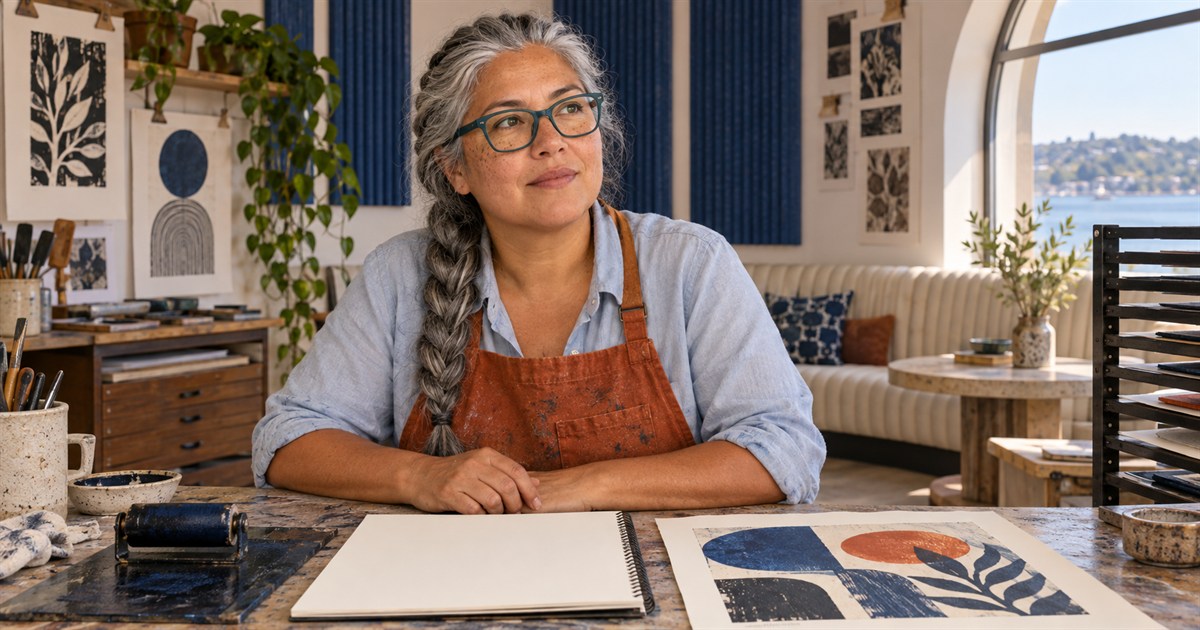
Fictional illustration, not a claimed clairvoyant experience: Rosa notices a leaf with a curved edge outside a window. She sketches the curve, repeats it three times, and tries two colour combinations for a small print.
The result looks different from the image she first imagined. Rather than treating the difference as a failure, Rosa notices that the uneven spacing makes the print more lively. She keeps that feature and changes the colours.
The process uses observation, invention, and revision. It does not show that the leaf predicted the artwork or that Rosa’s image controlled reality. The creative discovery is enough on its own.
Before-and-after reflection prompts
Use these prompts to keep the exercise specific:
- Before: what am I observing, and what small thing would I like to try?
- Before: what time, material, or comfort limit will I keep?
- During: which details come from observation, and which am I inventing?
- After: what did I actually make or describe?
- After: what changed from the first idea, and what did that teach me?
- Next: do I want to revise, leave it, or try a different format?
A practical next step might be to redraw one curve tomorrow or explain the idea to a willing friend. You do not need to make the activity a daily obligation or turn each result into a sign.
Symbols are prompts, not commands
If a doorway, bird, colour, or other symbol appears in your imagination, start with your own associations. “This reminds me of freedom” is a personal interpretation. “I must leave my relationship immediately” adds a directive that the symbol does not establish.
Likewise, an imagined scene about someone else is not evidence of their intentions or conduct. Ask appropriate questions and consider actual behaviour instead of making an accusation. A health-related image is not a diagnosis. Keep professional care and important decisions anchored in relevant evidence.
If you want to evaluate an apparent prediction, write the exact claim before the outcome, include a deadline and prior information, and keep misses as well as matches. That is a different activity from creative work and should be assessed separately.
Keep the freedom to pause
The third eye can be used as a spiritual or contemplative metaphor. You do not need to activate a medical organ or complete a ritual to end this exercise. Put down the materials, look around, and return to an ordinary activity when you are finished.
If imagery becomes frightening or hard to disengage from, pause and seek appropriate support when needed. Closing Your Third Eye discusses stepping back from the practice without treating distress as proof of an outside force.
Imagination can make room for possibilities while leaving you in control of what you do next. You can dream broadly, make something small, and revise it honestly—without demanding that every picture become reality.
Frequently Asked Questions
Is imagination the same as clairvoyance?
No. Imagination involves forming or working with ideas and possibilities. Clairvoyance, in psychic usage, claims perception beyond ordinary senses. A creative image does not by itself establish hidden knowledge.
Can visualising something guarantee that I create it?
No. Visualisation may help you describe an idea, but outcomes also depend on action, resources, constraints, other people, and chance. An unmet goal is not evidence that you imagined incorrectly.
What if I cannot see pictures in my mind?
Use words, photographs, sound, movement, objects, or a simple diagram. A lack of voluntary visual imagery does not mean a lack of imagination, and you do not need to force an inner picture.
Can I do the exercise with my eyes open?
Yes. Choose an ordinary object in comfortable light, describe what you notice, and make a small creative variation on paper or in words. Do not stare at bright light or strain your eyes.
Is the third eye a medical organ?
The third eye is used as a spiritual or contemplative concept. It is not a required medical organ to activate for this exercise, and the term does not establish paranormal perception.
How do I keep a symbol separate from a factual claim?
Record the image first, then label your interpretation as one possible meaning. If you make a specific claim about the world, evaluate it separately against evidence rather than treating the symbol as proof.
What should I do if an exercise becomes distressing?
Stop, return attention to your ordinary surroundings, and choose another activity. Seek appropriate professional support if distress or unusual experiences persist or affect daily life; do not force the exercise to continue.