

Quick Guide
“Opening the third eye” is spiritual language, not a medical procedure or a guaranteed route to clairvoyance. The five steps below offer a short, optional attention exercise: get comfortable, breathe without forcing, choose a simple focus, notice what happens, and finish with a grounded reflection. Keeping your eyes open is welcome.
You may have encountered third-eye exercises that ask you to picture numbers, concentrate between your eyebrows, or wait for a special sensation. It is reasonable to be curious about those practices. It is also reasonable to prefer an ordinary observation exercise, find visualization unhelpful, or stop completely.
This version keeps the original five-step structure without asking you to activate a gland, produce a vision, or interpret discomfort as success. Its purpose is to help you notice the difference between what you choose to imagine, what you observe, and what you later infer. It is not a diagnostic tool, a treatment, or a test of spiritual worth.
What “Third Eye” Means Here
In this article, third-eye language is used as a contemplative metaphor for inner awareness. It should not be confused with ordinary eyesight or with evidence that a person can see hidden facts. A meaningful image can remain meaningful without becoming a prediction.
The pineal gland is a real endocrine organ. The medical reference Endotext’s account of pineal physiology describes its role in producing melatonin and conveying information about the light-dark cycle. That physiology does not establish that visualizing numbers opens a psychic channel. Nor does the presence of a pinecone in religious art establish a biological mechanism for clairvoyance.
For a broader reflection on the language, see opening your third eye to find your path. If your real question is whether you are allowed to stop, go directly to closing your third eye and setting practice boundaries. You do not have to complete an opening exercise first.
1. Get Comfortable and Choose a Limit
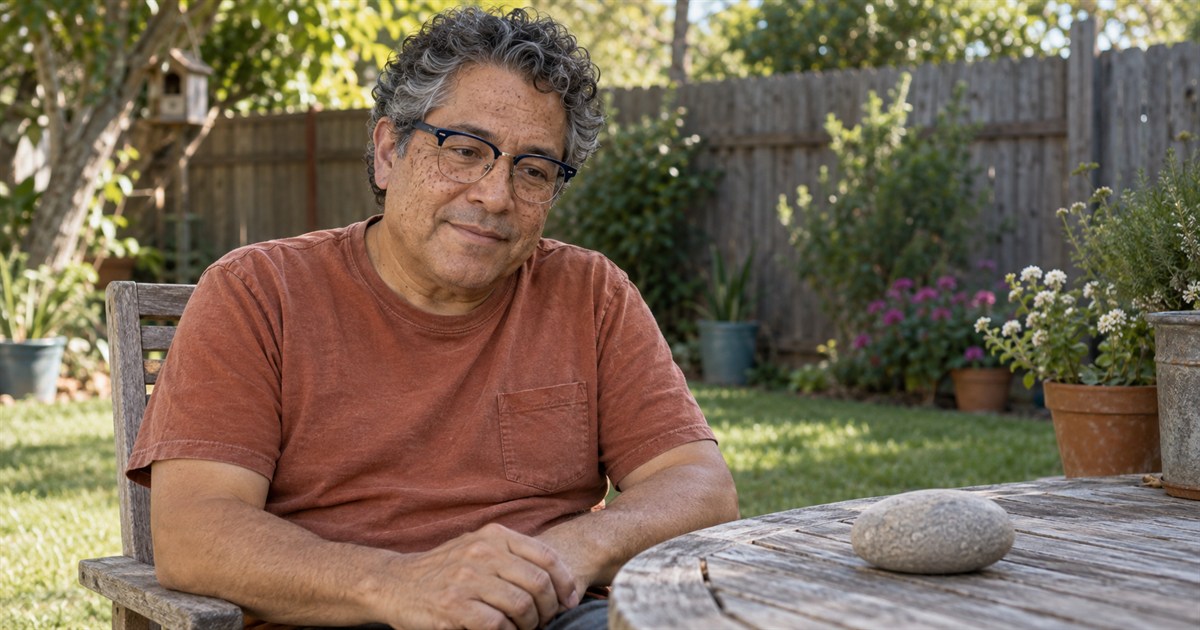
Pick a familiar place where you are not driving, supervising something hazardous, or needing to divide your attention. A normal chair at home or a seat in your yard is enough. There is no need for special equipment, incense, darkness, a paid session, or a carefully decorated meditation room.
Choose a short boundary before starting: “I will try this for a minute or two, and I can stop sooner.” This is a practical limit for the optional exercise, not a research-backed dose or an instruction to persevere until the time is up. Sit in a position that is comfortable for you and leave your eyes open if you prefer.
Before beginning, jot down one ordinary observation about your current state: “I am curious,” “I am distracted by work,” or “I do not feel like doing this today.” The last answer is a valid reason to skip the exercise. Avoid beginning with a prediction such as “I will definitely see a message,” which turns a simple activity into a performance demand.
2. Breathe Comfortably, Without a Test to Pass
Let your breathing remain gentle. You do not need to take the largest possible breath, hold it, count perfectly, or prove that you are breathing from the right place. If paying attention to breathing is uncomfortable, leave it alone and use an object in the room as your focus.
The NHS breathing guidance emphasizes comfortable, unforced breathing. This article’s short imagination activity is not the NHS’s full breathing routine and does not require changing your breathing pattern. Stop if you feel dizzy, strained, or unwell; do not label that feeling an awakening.
There is nothing to earn by making the exercise more intense. The useful question is whether the activity feels manageable, not whether you can produce a particular physical sensation.
3. Choose One Simple Focus
If you enjoy voluntary imagery, think of the number one for a moment. You might picture a printed digit, think the word “one,” or simply understand the idea without seeing an internal picture. Let any image be faint, brief, or absent. You do not need to hold it still.
If numbers feel tedious, choose a familiar shape such as a circle. Keep the task ordinary: “I am thinking about a circle,” rather than “A circle is being sent to me.” Do not use another person’s private life, a frightening event, or an important medical or financial decision as the subject.
Research summarized by the University of Exeter describes variation in mental imagery, including aphantasia. Lacking voluntary visual imagery does not mean lacking imagination. This exercise cannot diagnose aphantasia, and it should not promise that practice will make everyone see mental pictures.
An Eyes-Open Alternative
Look at an ordinary object already nearby: a cup, a leaf, or a smooth stone. Blink naturally and notice two visible details, such as its color and outline. You can then write those details down. Do not stare at a bright light, suppress blinking, or try to project another image into your surroundings.
This is a direct observation exercise, not an advanced stage of clairvoyance. If you would rather use a word or a simple sketch, that also works as a way to record your attention. Choose the version that asks less of you, not the version that sounds more impressive.
4. Notice, Rather Than Escalate
If you pictured “one” and still want to continue, you may try “two.” You can also stop with the first number. Reaching ten does not certify a gift, and losing track does not mean that something is blocked.
Notice the difference between a chosen image and an added interpretation. “I thought of a blue circle” describes the activity. “The blue circle means my friend will call tomorrow” adds a claim that the exercise does not establish. There is no need to turn the image into a message at all.
A wandering thought is simply something to record or leave alone. You may return to the chosen focus once, change to the eyes-open version, or finish. Avoid repeatedly restarting until the experience seems significant. You do not need a dramatic result to justify the time you spent.
Do not monitor your forehead for proof. Tingling, pressure, or a lack of sensation cannot certify a spiritual opening. If an uncomfortable symptom appears, stop and treat it as a health concern when appropriate, not as a reason to push further.
5. Finish With a Before-and-After Reflection
End deliberately. Look around the real room or yard, notice something familiar, and return to an ordinary activity. You do not need an elaborate closing ritual to make stopping legitimate.
A short record can keep observation separate from interpretation:
- Before: What was I hoping to do, and how did I feel?
- Chosen task: A number, a word, a sketch, or an object?
- What happened: Describe only what you noticed, including no image or distraction.
- Interpretation: What meaning did I add, if any?
- After: Did I feel comfortable, unchanged, distracted, or unsettled?
- Next choice: Leave it there, choose a different activity, or discuss a concern with someone appropriate.
This is a reflection note, not a psychic score. “Unchanged” and “not for me” are useful outcomes. You may decide that reading, drawing, gardening, or taking a quiet break suits you better.
A Fictional Example: A Number Is Not a Message
The following example is fictional. Rafael tries the exercise at his kitchen table. He thinks of the number one but sees no clear internal picture. He then notices the rounded handle of his green mug and writes, “Green mug, curved handle, distracted by tomorrow’s appointment.”
He is tempted to interpret the number one as a sign that an appointment will go perfectly. Instead, he records that this was an association he added after choosing the number. He checks the appointment time in his actual confirmation message and puts the notebook away.
The useful result is not a prediction or an awakening. Rafael distinguished an ordinary thought from information he could verify, and he stopped without trying to force a more impressive experience.
When to Stop and Seek Support
The National Center for Complementary and Integrative Health notes that meditation practices vary, evidence about harms is limited, and negative experiences can occur. Meditation should not replace healthcare or delay assessment. This brief exercise is optional and is not a treatment recommendation.
Stop if it leaves you distressed or feeling less connected to your surroundings. If unusual experiences persist, interfere with sleep or daily life, or feel difficult to manage, seek qualified support. An image is not a diagnosis, an instruction to change medication, or a command to harm yourself or someone else. If you cannot stay safe, seek immediate local emergency help.
New visual symptoms deserve particular care. The NHS advises urgent assessment for new or suddenly increased floaters or flashes, a dark curtain or shadow, or accompanying blurred vision or eye pain. Do not explain these away as third-eye development.
You can remain interested in spirituality while taking ordinary health concerns seriously. Choosing not to continue is a complete decision, not a failure to finish a process.
Frequently Asked Questions
Is the third eye a medical organ?
The third eye is a spiritual concept, not a separate medical eye that this exercise opens. The pineal gland is a real endocrine organ involved in melatonin production, but that does not establish it as a channel for psychic information.
Can visualization guarantee psychic perception?
No. Imagining a number, remembering a shape, or noticing a vivid image does not demonstrate knowledge obtained beyond the ordinary senses. Treat the exercise as optional attention or imagination practice, not a psychic test.
Do I have to close my eyes?
No. Keep your eyes open if that is more comfortable. You can look at an ordinary object, blink naturally, and describe what is actually present without trying to create another image over it.
What if I cannot picture the numbers?
Use words, a simple drawing, or direct observation instead. People differ in their ability to form mental images. A blank mental picture is not a spiritual failure, and you do not need to force one.
Does forehead tingling mean my third eye is opening?
A sensation alone does not prove a spiritual awakening. Do not press on your forehead or continue an uncomfortable exercise to intensify it. Stop if you feel unwell and seek appropriate care for new, persistent, or concerning symptoms.
How long should I practice?
This optional version is deliberately brief: one or two minutes is enough to try it, and you may stop sooner. There is no required daily streak, progression to ten numbers, or deadline for producing imagery.
What should I do if an exercise feels distressing?
Stop the exercise, look around your actual surroundings, and return to a familiar activity if you can. Do not treat distress as a required breakthrough. Seek professional support if symptoms persist or affect daily life, and urgent help if you cannot stay safe.