

If you believe in psychic gifts, your birth chart can feel like a language for experiences you have not quite found words for: vivid dreams, a strong inner image, emotional sensitivity or a quiet sense of knowing. Exploring that symbolism can help you give your spiritual interests a thoughtful place in everyday life.
Begin with a few clear features rather than searching the whole chart for a label. In modern Western astrology, the Moon, Mercury and Neptune offer useful starting points for receptivity, communication and imagination. Their signs, houses and relationships add context to the story.
Start with a chart you can read clearly
A natal chart uses your birth date, local birth time and birthplace. Before interpreting it, note whether the time is recorded, remembered approximately or unknown. Keep the zodiac and house system named on your chart so you can follow the same method throughout.
- With a recorded time: check that the date, place and local time were entered correctly.
- With an approximate time: keep time-sensitive interpretations tentative, especially angles and houses.
- With an unknown time: use a chart setting that makes the uncertainty clear. A noon placeholder is not a verified birth time. The Moon can also change position enough during a day to affect a sign or aspect interpretation.
You do not need to understand every line on the wheel. Find one planet in the placement list, read its sign and degree, and identify one aspect involving it. If terms such as clairvoyance or clairsentience are new to you, our guide to the clair gifts explains how practitioners use them.
Read a symbol, then give it a place in your life
Use this four-step route for one feature at a time.
Locate the feature
Write the planet, sign and degree. Add the house only when the birth information supports it.
Read the connection
Find an aspect and note the other planet. Keep the complete relationship in view.
Ask an open question
Turn the symbolism into a question about attention, dreams, compassion or expression.
Try a gentle practice
Keep a short journal, notice what fits and review your experience before adding more.
Chart themes often explored with intuitive interests
The following associations belong to modern astrological interpretation. They can offer a language for your spiritual life; they are not a measurement or certification of psychic ability.
The Moon
Explore feelings, familiar responses and what helps you feel inwardly settled. Moon–Neptune themes may invite reflection on compassion, emotional imagination and the need to distinguish your feelings from someone else’s.
“What helps me listen without taking on every feeling around me?”
Neptune
Modern astrologers often connect Neptune with dreams, imagination, compassion and experiences of connection. Work with the imagery through a dream notebook, quiet contemplation, music or creative expression.
“Which images keep returning, and what do they mean to me?”
Mercury
Mercury brings attention to learning and communication. A Mercury–Neptune theme can become a practice in describing a subtle impression clearly before turning it into a story or sharing it with someone.
“What did I actually notice, and how can I describe it simply?”
Water-sign emphasis
Cancer, Scorpio and Pisces are associated with receptive and emotional themes. You might explore belonging, depth or compassion through them. Air, earth and fire placements can also contribute useful ways of thinking, grounding and acting.
“How do my feelings, ideas and actions work together?”
Houses add an area of life. The twelfth house is often explored through dreams, retreat and private spiritual practice; the fourth through home and inner foundations; and the eighth through depth, trust and change. A house is a different chart layer from a sign. Pisces and the twelfth house, for example, are not interchangeable.
For a closer look at the language people use for their experiences, read the different types of intuition. There is no need to force a one-to-one match between a planet and a particular clair gift.
What do the aspect lines add?
An aspect describes an angular relationship between chart points. The name tells you about that relationship within astrology; it does not rank people from least to most gifted.
- Conjunction · 0°
- Read the two planetary themes together. Ask how they blend or become difficult to separate.
- Sextile · 60°
- Explore a connection that may become useful through attention and practice.
- Square · 90°
- Look for a tension to work with, such as balancing a compelling impression with a clear description.
- Trine · 120°
- Often read as ease or flow. Ask how to give that theme a conscious, constructive expression.
- Opposition · 180°
- Explore a dialogue between two themes and what helps you hold both in view.
The orb is the distance from an exact aspect angle. Different astrologers and software settings allow different orbs, so record the actual degrees and the method you are following. Two planets being in water signs does not, on its own, establish an exact trine.
Two sample birth charts, explained step by step
These simplified teaching wheels show only the planets used in each example. They use hypothetical placements, the tropical zodiac and whole-sign houses, so each zodiac sign fills one house. They are not complete calculated charts for actual people.
How to read the wheels
- Start with ASC. This marks the Ascendant, or rising degree. In whole-sign houses, its entire zodiac sign is House 1; the ASC can sit inside that house.
- Read the outer ring. It names the zodiac signs. A placement such as 18° Cancer means 18 degrees into Cancer, not 18 degrees around the whole wheel.
- Find the house number. Houses add an area of life. Follow the sign and planet into the numbered sector.
- Follow the colored line. It highlights the aspect being discussed. Other planets and aspects have been left out to keep the lesson clear.
Example 1: Mercury trine Neptune
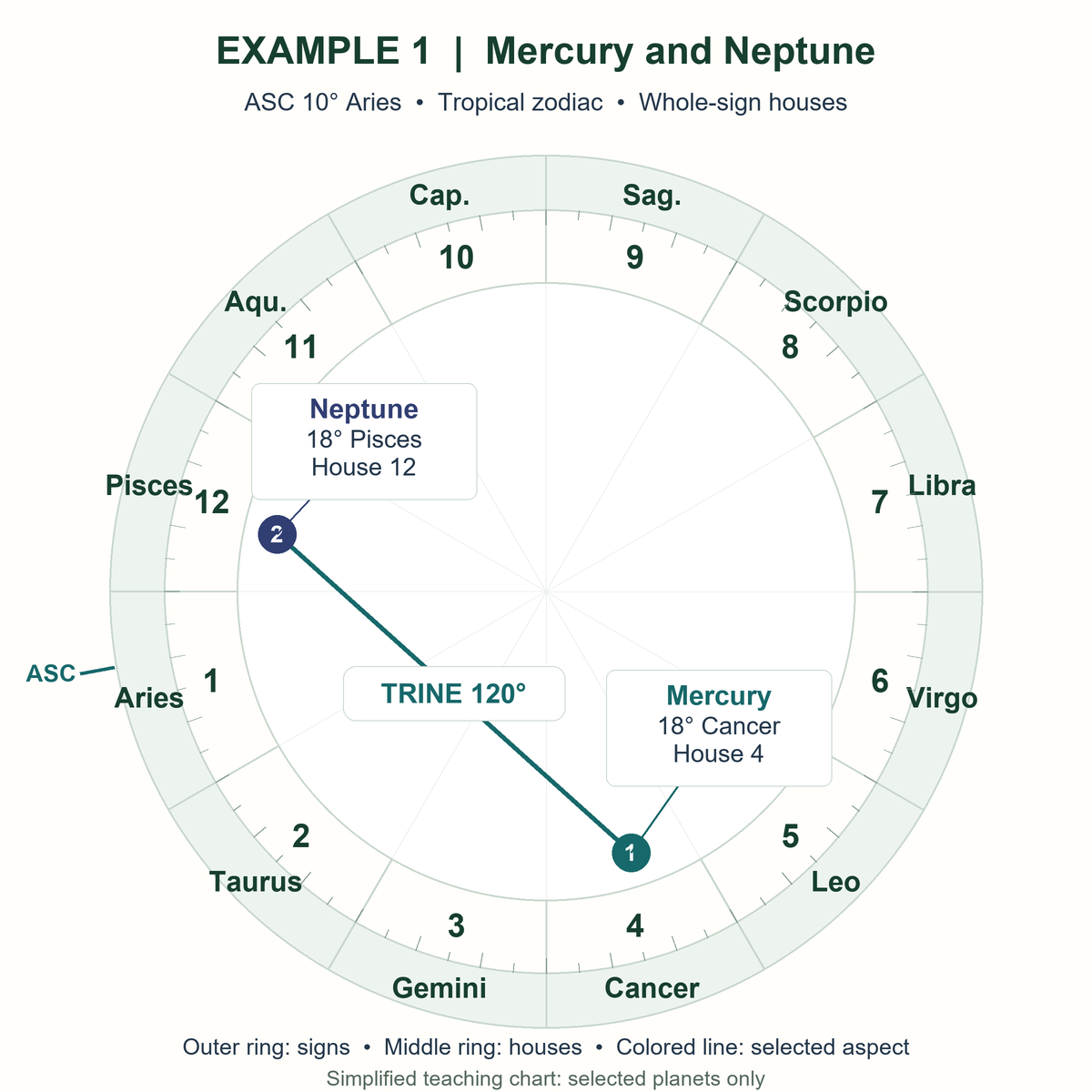
- Find the rising sign and houses. The ASC is 10° Aries. Aries fills House 1, Taurus fills House 2, and the signs continue in order. Cancer is therefore House 4 and Pisces is House 12.
- Locate the two planets. Mercury is at 18° Cancer in House 4. Neptune is at 18° Pisces in House 12. Read the planet, sign and house together.
- Check the aspect. Cancer starts at 90° of the zodiac, placing Mercury at 108°. Pisces starts at 330°, placing Neptune at 348°. The shorter distance between them is 120°: an exact trine, with a 0° orb.
- Build a reflective interpretation. Mercury contributes words and learning; Neptune contributes imagination and spiritual imagery. The fourth-house setting brings the question into home and inner foundations, while the twelfth adds dreams, solitude or private spiritual practice.
A way to explore the symbolism: “How can quiet time at home help me put a meaningful dream into words?” Keep a notebook nearby, describe the dream first and add your associations afterward. In this reading, the trine is a theme of flow that you can give a conscious expression.
Example 2: Moon opposite Neptune
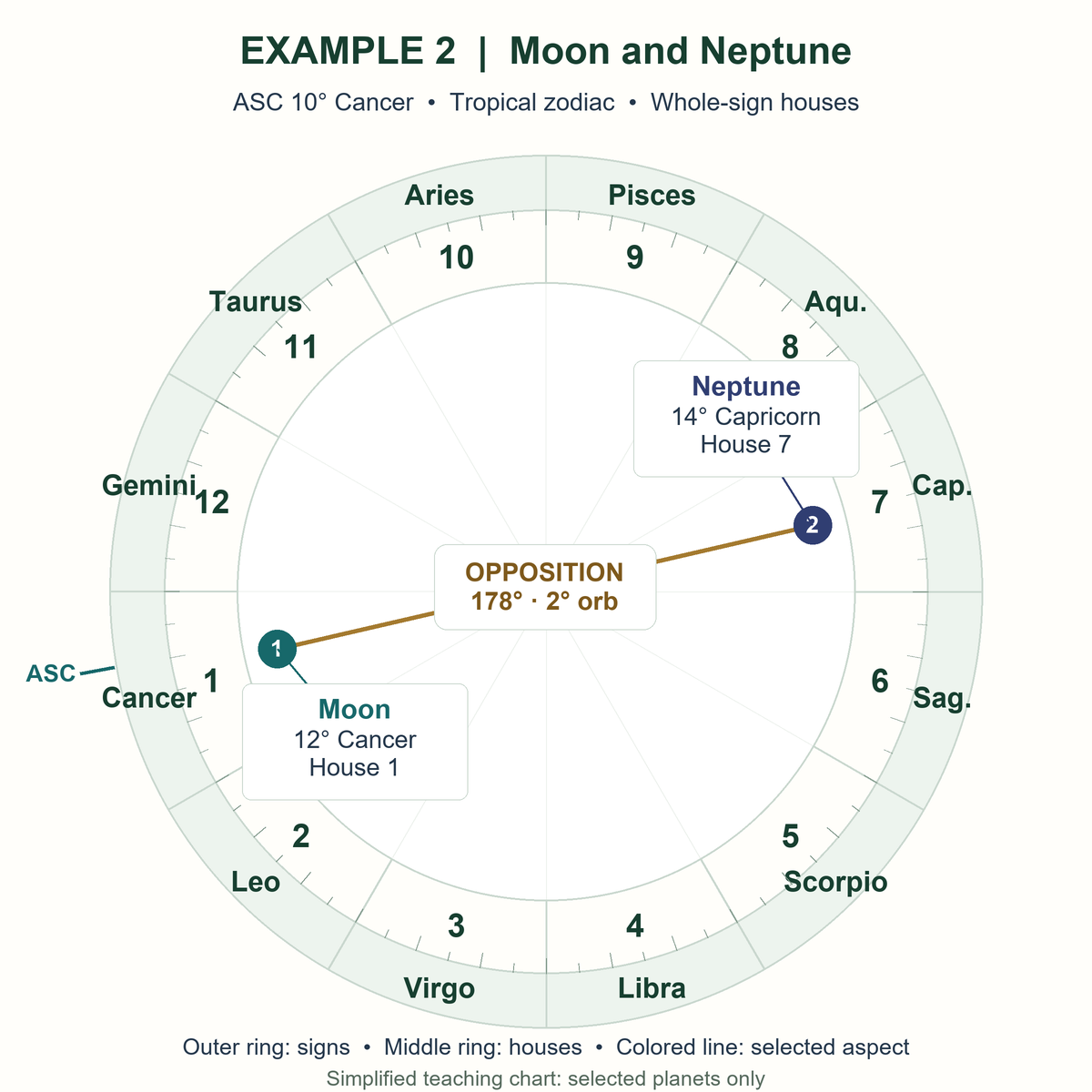
- Begin with a different rising sign. Here the ASC is 10° Cancer. Cancer fills House 1, Leo fills House 2, and Capricorn fills House 7. The same zodiac sign does not always occupy the same numbered house in different charts.
- Read the planets in their houses. The Moon at 12° Cancer sits in House 1, bringing emotional responses and self-awareness into focus. Neptune at 14° Capricorn sits in House 7, inviting reflection on hopes, ideals and sensitivity within one-to-one relationships.
- Calculate the angle and orb. The Moon is at 102° of the zodiac and Neptune at 284°. Their shorter separation is 178°. An opposition is exact at 180°, so this example has a 2° orb. Check the orb allowance used by your chart or astrologer.
- Explore the relationship between the themes. An opposition can become a dialogue between your own feelings and what you imagine or hope another person feels. It invites awareness and balance; it is not a judgment about the relationship.
A way to explore the symbolism: “Can I stay close to my own feelings while listening openly to yours?” Before a conversation, write what you feel and what you are assuming. Then ask the other person about their experience and allow their answer to add something new.
What the two examples teach: the planet supplies a theme, the sign describes its style, the house adds an area of life, and the aspect connects two themes. The first example leads toward a private dream-writing practice; the second toward emotional awareness and clearer relationship boundaries.
Try the same sequence with one feature in your own chart. Copy the placements accurately, confirm the aspect in its aspect table and turn the interpretation into an open question. For help putting an inner image into words, see our guide to interpreting clairvoyant images.
Explore one chart theme over a week
Choose a practice that feels inviting and manageable. You might use a Moon theme for an emotional check-in, a Neptune theme for dream reflection, or a Mercury theme for putting impressions into clear words.
- Begin with one question. Write the chart feature accurately and choose a gentle intention, such as “I want to notice my impressions with patience.”
- Keep short daily notes. Spend a few comfortable minutes recording a dream, image or feeling. Note the setting and what you already knew before interpreting it.
- Review at the end of the week. Notice what felt meaningful, what remained unclear and what differed from your first interpretation. Choose one practice to keep or adjust.
If dreams are your starting point, our guide to repeatedly dreaming about someone offers questions about personal associations and the dream’s emotional story. For daily decisions, using intuition thoughtfully connects an impression with a considerate question or practical next step.
A journal entry you can adapt
- Chart feature
- Mercury–Neptune theme: imagination and expression.
- Exact impression
- I wake remembering an image of a friend carrying a heavy bag.
- What I already know
- They mentioned having a busy week.
- Personal meaning
- The image makes me think about support and sharing responsibilities.
- My response
- I ask, “Would a check-in be welcome?” and accept their answer.
- Later observation
- I record what they actually share, including anything that differs from the original impression.
Your private spiritual meaning can stay meaningful even when an image is not a literal message. Keeping the first note intact lets you see your experience more clearly over time.
Let sensitivity include room to rest
A spiritual practice can include quiet time, clear limits and ordinary enjoyment. You do not need a dramatic experience at every sitting or a new interpretation for every feeling. Our guide to psychic interests in daily life offers ways to keep exploration balanced with relationships, work and rest.
Before sharing an impression about someone, ask whether they want to hear it. Let them describe their own feelings, and avoid treating a chart as permission to reveal or define their private life.
A chart cannot diagnose an illness, establish someone’s trauma or guarantee an event. If an interpretation becomes frightening, pressured or disconnected from what you know about your life, step back and seek appropriate support rather than adding more alarming predictions.
Questions to bring to a reading
- Which tradition, zodiac and house system are you using?
- How reliable is my birth time, and which parts of this interpretation depend on it?
- Can you explain how the planet, sign, house and aspect fit together?
- What open question or gentle practice could I take from this theme?
- What other parts of the chart would you consider before reaching a conclusion?
You can ask for clarification, disagree or take time to reflect. Our article on the limits of clairvoyant readings can help you keep meaning and certainty separate when discussing impressions or predictions.
Birth charts and psychic gifts: 22 FAQs
Practical answers about chart symbols, birth-time uncertainty and developing your spiritual practice.
1. Can a birth chart show psychic gifts?
Astrologers may use a birth chart to explore themes such as sensitivity, dreams and intuitive interests. It offers a symbolic framework for reflection; a placement does not, by itself, establish paranormal ability.
2. Which planets should I start with?
Begin with the Moon, Mercury and Neptune. In modern Western astrology, they provide useful starting points for emotional receptivity, the way you describe impressions, and imagination or spiritual longing.
3. Do I need a strong Neptune placement to explore intuition?
No. You can develop a reflective spiritual practice without a particular placement. Neptune is one interpretive theme among many, and the whole chart matters more than a single symbol.
4. What might Moon–Neptune aspects mean?
Modern astrologers often explore them through emotional sensitivity, compassion, imagination and the need for boundaries. A useful question is how to listen with care while allowing another person to speak for themselves.
5. What might Mercury–Neptune aspects mean?
They can be read symbolically through imagination, images, storytelling and the expression of subtle impressions. Try writing down an image or dream before deciding what meaning it holds for you.
6. Are water signs automatically psychic?
No. Cancer, Scorpio and Pisces are associated with emotional and receptive themes in modern astrology, but a water-sign placement does not automatically establish a psychic gift or exclude other signs from intuitive practice.
7. What does the twelfth house add to this discussion?
Many modern astrologers connect it with retreat, dreams, contemplation and private spiritual life. It can prompt questions about restorative solitude and how to bring an inner practice into everyday life.
8. Does an empty twelfth house mean I lack spiritual gifts?
No. An empty house is not an absence of that area of life. You can explore its sign and ruler within your chosen tradition, and you do not need a planet there to enjoy dream work or meditation.
9. Are Pisces and the twelfth house the same thing?
No. Pisces is a zodiac sign; the twelfth house is a sector of the chart. Some modern approaches connect their symbolism, but they remain different parts of an interpretation.
10. What is an aspect?
An aspect is a defined angular relationship between chart points. Common examples include a conjunction near 0°, a sextile near 60°, a square near 90°, a trine near 120° and an opposition near 180°.
11. What is an orb?
The orb is the difference between an exact aspect angle and the angle shown by the placements. Astrologers use different allowances, so check the settings and method behind an interpretation.
12. Is a trine better than a square for intuitive development?
A trine is often interpreted as ease or flow, while a square suggests a theme that needs attention and practice. Neither is a reliable ranking of psychic ability, and both can become useful reflection prompts.
13. Why do many people share Neptune in the same sign?
Neptune moves slowly and takes about 165 Earth years to orbit the Sun. Many people therefore share its zodiac-sign placement; personal-planet aspects and the wider chart add interpretive context.
14. What if I do not know my birth time?
Keep the time marked as unknown or approximate. Avoid treating precise angles and house placements as established, and check whether the Moon or another placement changes across the possible birth-time range.
15. Should I enter noon when my birth time is unknown?
A placeholder time may help software draw a limited chart, but it is not your verified birth time. Keep that distinction clear and do not read the resulting houses or angles as certain.
16. Can changing the house system change an interpretation?
Yes. A planet can appear in a different house under different systems. Record the system you use and compare interpretations thoughtfully rather than choosing whichever version gives the most flattering result.
17. How can I begin a dream practice linked to my chart?
Choose one theme, such as imagination or emotional receptivity. Record a dream soon after waking, note its feeling and your personal associations, and choose a small reflective question for the day.
18. Does a vivid dream reveal another person’s thoughts?
Vividness does not establish private information about another person. You can welcome a dream’s personal or spiritual meaning while asking for consent before bringing it into a conversation with them.
19. How long should I practise each day?
A few comfortable minutes can be enough for this exercise. Choose a manageable rhythm, keep ordinary routines intact and stop before the practice feels pressured or repetitive.
20. What should I write in an intuition journal?
Record the date, chart theme, exact impression, what you already knew and what happened later. Keep your personal interpretation separate and include unclear results or differences from the first impression.
21. Can an astrologer diagnose an illness or guarantee my future?
No. A chart interpretation cannot establish a medical condition or guarantee an outcome. Bring questions about symbolism and choices to the reading, and use appropriate professional support for health concerns.
22. What is the most useful first step?
Choose one clear chart feature, turn it into an open question and try one gentle practice for a week. Review what you actually experienced before adding more techniques or interpretations.