

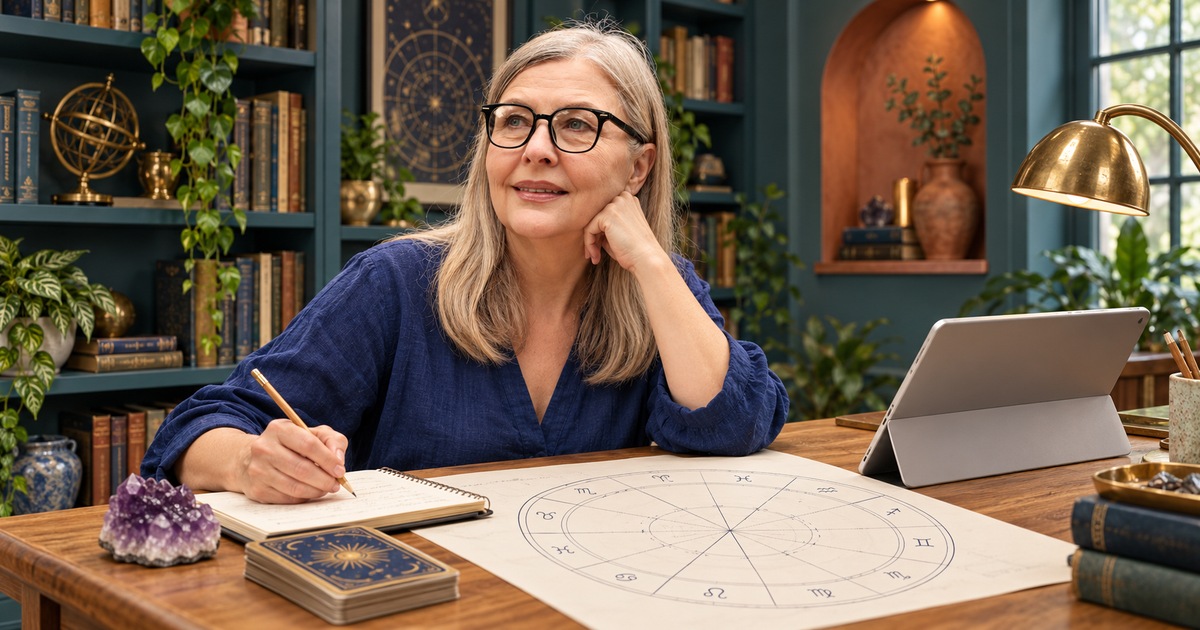
A birth chart can offer a rich language for exploring intuition, imagination and spiritual interests. If you feel drawn to dreams, inner images or a strong sense of knowing, you may wonder how those experiences fit the symbols in your chart.
Use the chart to begin a conversation with yourself. A placement can suggest a question to explore; it cannot certify a psychic gift, establish another person’s thoughts or determine what your future must become.
Read three parts of the chart together
1. The symbol
Which planet or point are you exploring? Begin with the theme it represents in your chosen astrological tradition.
2. The relationship
What aspect or chart context is being discussed? Keep the complete description, rather than selecting one dramatic phrase.
3. Your experience
What fits your life, what does not and what useful question follows? Your experience does not have to match every interpretation.
Work with a chart based on your recorded birth date, local time and birthplace. Keep any uncertainty visible. If the time is unknown, do not treat a precise Ascendant, Midheaven or house placement as established.
A planet’s sign, its house and its aspects are different layers of an interpretation. You do not need to master every symbol in one sitting. Choose one theme, write down the chart information accurately and give yourself time to explore it.
Why Neptune appears in discussions of intuition
Modern astrological interpretations often connect Neptune with imagination, spiritual longing and sensitivity. In that symbolic language, it can prompt questions about inspiration and the line between a compelling image and a checked fact.
The astronomical planet moves slowly: NASA describes an orbit of about 165 Earth years. Some outer-planet patterns are shared by many people. A shared placement is not a personal certificate of unusual ability.
Four themes to explore without assigning a fixed identity
Moon–Neptune themes
Consider emotional receptivity and compassion. How can you listen carefully while allowing someone to describe their own feelings?
Mercury–Neptune themes
Explore imagination and expression. What helps you record an impression clearly before interpreting it?
Neptune and chart angles
Reflect on boundaries and public roles. How do you offer kindness without becoming responsible for everyone’s decisions?
Twelfth-house themes
Explore private reflection and dreams. What helps your inner life support a connected, practical everyday life?
These are prompts you can adapt, rather than descriptions you must accept. Different aspect names do not form a ranking of who is most gifted. Nor does the absence of a favored placement exclude you from a spiritual practice.
Distinguish an image, an interpretation and an observation
A vivid image can be meaningful without being information about someone else’s life. An interpretation is what you make of the image; an observation is what you can later establish happened.
Keep those pieces separate when journaling. If you imagine a friend looking tired, record that impression before asking how they are. Their answer may fit, differ or provide too little information to judge. Do not rewrite the first note to make it seem more specific.
Our guide to using intuition thoughtfully offers ways to turn impressions into questions. For the language practitioners use, see understanding the clair gifts.
Try one chart theme in an ordinary week
- Choose one theme. For example, use a Mercury–Neptune interpretation to explore how you express intuitive ideas.
- Write a gentle intention. “I want to describe my impressions before deciding what they mean.”
- Record a small experience. Note the date, context and exact impression without adding a prediction afterward.
- Consider alternatives. Include memory, familiar patterns, hopes and information you already knew.
- Review honestly. Keep unclear results and misses alongside apparent matches.
- Choose a practical response. Ask a considerate question or clarify a detail instead of acting as though the impression is certain.
This is a reflection practice, not a test that can certify paranormal ability. Its immediate value is a clearer record of your attention and decisions.
A worked journal entry
Chart theme: Imagination and communication.
Impression: I picture a friend feeling overwhelmed.
What I already know: They recently mentioned a busy week.
Question: “Would you welcome a check-in?”
Later observation: Record what they actually share, including anything different from the first impression.
Boundary: Their answer belongs to them; I do not need to insist that I knew it in advance.
Let sensitivity include boundaries
If you identify with a chart description of sensitivity, ask what helps you stay comfortable and connected. You may need quiet time, a clearer schedule or permission to decline a conversation. Those choices do not depend on proving that you absorb another person’s energy.
Do not use a chart to diagnose illness, explain away distress or assign trauma that someone has not described. Spiritual reflection can sit alongside appropriate practical support. You remain more than any single placement.
Questions to bring to a reading
- Which chart information and interpretive tradition are you using?
- What changes if my recorded birth time is uncertain?
- Can you explain the symbol as an open question?
- How might I explore this theme without making claims about other people?
- What practical choices remain mine?
A useful reading should help you reflect without requiring you to accept every interpretation. You can ask for clarification, disagree or stop. A promise that a placement guarantees wealth, healing or psychic mastery is not something the chart can establish.
Frequently asked questions
1. Can a birth chart prove I have psychic gifts?
No. It can provide spiritual or symbolic reflection, but a placement cannot establish paranormal ability.
2. Can I explore intuition without a special placement?
Yes. A favored chart pattern is not a prerequisite for journaling, spiritual reflection or considerate listening.
3. Why is Neptune often mentioned?
In modern astrological symbolism, Neptune is commonly associated with imagination, spiritual longing and sensitivity.
4. Does one aspect define my whole personality?
No. Keep the wider chart and your actual experience in view rather than treating a phrase as a fixed identity.
5. Are signs, houses and aspects the same thing?
No. They are different layers of a chart interpretation. Learn one layer at a time and keep the full description clear.
6. What if I do not know my birth time?
Keep that uncertainty visible. Do not treat precise angles or house placements as established from an unknown time.
7. What can Moon–Neptune themes help me explore?
You might use them to reflect on compassion and how you listen, while letting others describe their own emotions.
8. How can I use Mercury–Neptune themes practically?
Try recording an impression clearly, separating it from your interpretation and checking what you actually learn later.
9. Does sensitivity mean I know another person’s thoughts?
No. Feeling strongly does not establish private knowledge. Ask respectfully and accept what the person chooses to share.
10. Why do outer-planet patterns appear in many charts?
Outer planets move slowly, so some configurations are shared. A shared pattern is not a unique identifier of a gift.
11. Should I record impressions before checking them?
Yes, if you are keeping a journal. Preserve the first wording and include misses and uncertain results alongside apparent matches.
12. Can a journal certify psychic ability?
No. This exercise can clarify your attention and decisions but does not establish a paranormal explanation.
13. Should I act immediately on an intuitive image?
Use it as a prompt for a careful question. Consider practical information, consent and consequences before acting.
14. Can a chart diagnose a health problem?
No. A spiritual interpretation cannot establish a medical condition or replace appropriate professional care.
15. What is a useful first step?
Choose one chart theme, write a question connected with daily life and try one small, considerate response.